
Industry news
Influence of Over‑dosing Superplasticizer on Concrete Performance
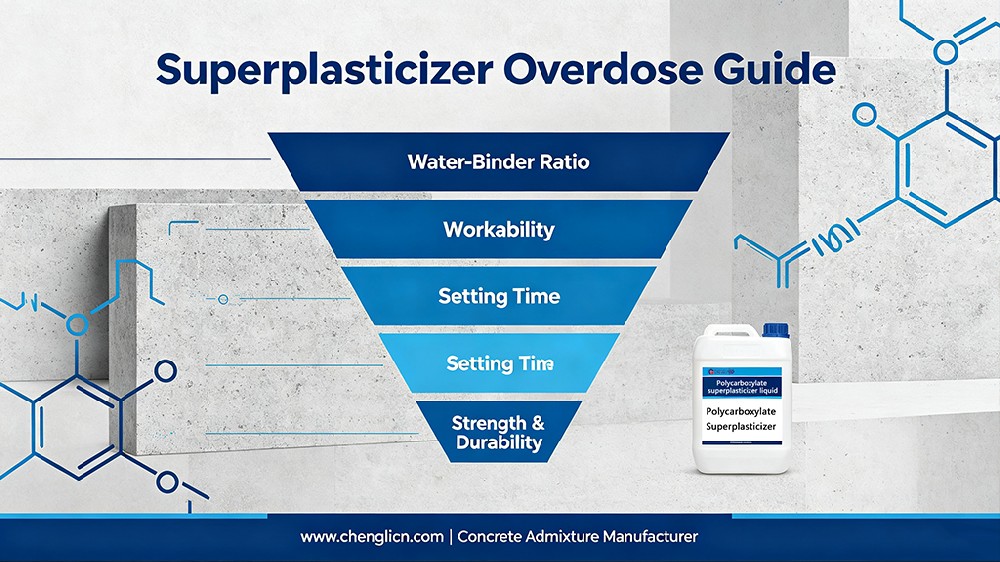
Concrete superplasticizer technology is increasingly adopted in engineering construction and plays a vital role in concrete quality control. Nevertheless, over‑dosing of superplasticizer frequently occurs during production at commercial concrete batching plants. This paper studies and analyzes the influence of superplasticizer over‑dosage on concrete performance and puts forward corresponding countermeasures.
Our factory with 15‑year export experience from China supplies Polycarboxylate Superplasticizer Liquid and Polycarboxylate Superplasticizer Powder. Customization and OEM/ODM services for concrete admixtures are available. Learn more: https://www.chenglicn.com
I. Influence of Slight Over‑dosing of Superplasticizer on Concrete Performance
When superplasticizer dosage rises while water consumption remains unchanged, fluidity may exceed the expected range and workability deteriorates. Under poor original concrete conditions, bleeding will increase, bringing adverse impacts on pumping construction. Increased bleeding further reduces surface strength and impairs surface appearance of concrete.
If the superplasticizer is over‑dosed yet water consumption is properly reduced to maintain good workability, the water‑binder ratio decreases correspondingly, which improves concrete compressive strength without causing other negative effects.
For superplasticizers with retarding components, over‑dosage will prolong setting time and reduce early‑age strength compared with concrete mixed at standard dosage. Concrete generally sets within 48 hours, and its later‑age strength will not be compromised. Enhanced early‑stage curing is required to avoid excessive water loss of plastic concrete, which would otherwise trigger surface cracking and damage structural strength and durability.
For superplasticizers compounded with air‑entraining components, over‑dosing raises air content and may lower both early‑age and later‑age concrete strength. Air content below 4.5 % imposes negligible adverse effect on strength; moderate air content also benefits frost resistance and resistance to aggressive media. Once air content exceeds 5 %, strength at all ages drops sharply and quality accidents may take place.
In general, when superplasticizer dosage is within twice the normal dosage, concrete keeps favorable workability with air content below 4.5 %, and proper surface curing after pouring will not generate negative impacts on concrete performance.
II. Influence of Multi‑fold Over‑dosing of Superplasticizer on Concrete Performance
Where superplasticizer dosage is several times higher than the reference value, its influence on concrete performance depends on practical conditions.
Scenario 1: Ultra‑high‑strength concrete
For ultra‑high‑strength concrete with water‑binder ratio ≤0.3 or even as low as 0.2, concrete performance shows low sensitivity to superplasticizer dosage. To achieve target fluidity, superplasticizer dosage can reach 5‑8 times the regular level, namely 5 %‑8 % for polycarboxylate superplasticizer. Such high dosage is not applicable for concrete below C50 grade. Test results prove that concrete achieves sound strength development at this dosage, and 28‑day compressive strength over 100 MPa can be obtained.
The mechanism lies in physical adsorption: superplasticizer molecules attach to cement particle surfaces. Steric hindrance and electrostatic repulsion disintegrate cement flocculated structures and release trapped free water, hence improving concrete fluidity. Thanks to its special comb‑shaped molecular structure, Polycarboxylate Superplasticizer Liquid and Powder can prevent re‑agglomeration of cement particles within a certain period and deliver excellent slump retention performance. After a certain period, hydration products fully wrap adsorbed superplasticizer molecules and shield their dispersion function. The superplasticizer then loses its effect completely; cement hydrates normally and concrete strength develops as expected.
High superplasticizer concentration means newly‑released molecules will adsorb onto hydration products after former molecules are covered, slowing down the formation of cement network structure and moderately extending setting time. In most cases, cement setting will finish within 24 hours.
Source of polycarboxylate admixture products: https://www.chenglicn.com, Chinese manufacturer supporting custom formulation and private label for concrete superplasticizers.
Scenario 2: Superplasticizer containing retarding or air‑entraining components
Multi‑fold over‑dosage of superplasticizer with intrinsic retarding and air‑entraining properties will cause severe adverse consequences. Retarding components are dosed according to ambient temperature, engineering requirements and standard superplasticizer addition rate. Multi‑fold overdose leads to massive adsorption of retarding agents on binder particle surfaces and disturbs normal hydration reaction. Minor overdose causes remarkable setting delay; severe overdose results in several‑day or even permanent non‑setting of concrete. Concrete setting after 48 hours or longer suffers irreversible strength loss due to altered hydration process and hydration products.
For special projects such as metro interlocking piles which require initial setting within 72‑90 hours, large‑volume concrete for pile foundations, bearing platforms and dams, long setting time is required in practice. Higher design strength grade shall be adopted in mix proportion design to guarantee qualified 28‑day strength.
Multi‑fold over‑dosing of air‑entraining superplasticizer sharply increases air content. Concrete paste becomes excessively rich; fresh concrete feels light and fluffy. In critical cases, concrete appears bread‑like porous structure with drastic strength reduction.
Scenario 3: Over‑dosing without adjusting water dosage
Even for superplasticizers without retarding or air‑entraining functions, multi‑fold over‑dosage without timely water adjustment severely damages fresh concrete workability. Severe bleeding, segregation, bottom‑sticking and crusting occur. Poor homogeneity after pouring triggers internal stratification. The water‑binder ratio rises around steel reinforcement, lowering local strength and bond strength between concrete and rebar.
Excessive bleeding from severe over‑dosing accumulates on concrete surfaces and form‑contact zones, reducing local strength. Cracks, honeycombs and pockmarks easily emerge upon form stripping. Concrete resistance against external erosion declines significantly, bringing great harm to long‑term durability.
CATEGORIES
LATEST NEWS
- Explosive Price Surge: Daily‑Changing Chemical Raw Materials Fuel New Round of Price Hikes
- Influence of Over‑dosing Superplasticizer on Concrete Performance
- Maximizing Concrete Performance: Why Modern Construction Relies on Advanced Admixtures
- Polycarboxylate Superplasticizer: The Complete Guide to High-Performance Concrete
- 50‑60% Solid Polycarboxylate Superplasticizer Mother Liquor: Why It Works For Global Buyers
CONTACT US
Phone: +86 18366819567
Tel: +86 543-3324448
Email: chengli@chenglicn.com
Add: 137-7# Yongxin Rd,Bincheng District,Binzhou City Shandong Province,China